


LM393 Comparator: 7 Pull-Up and Threshold Checks

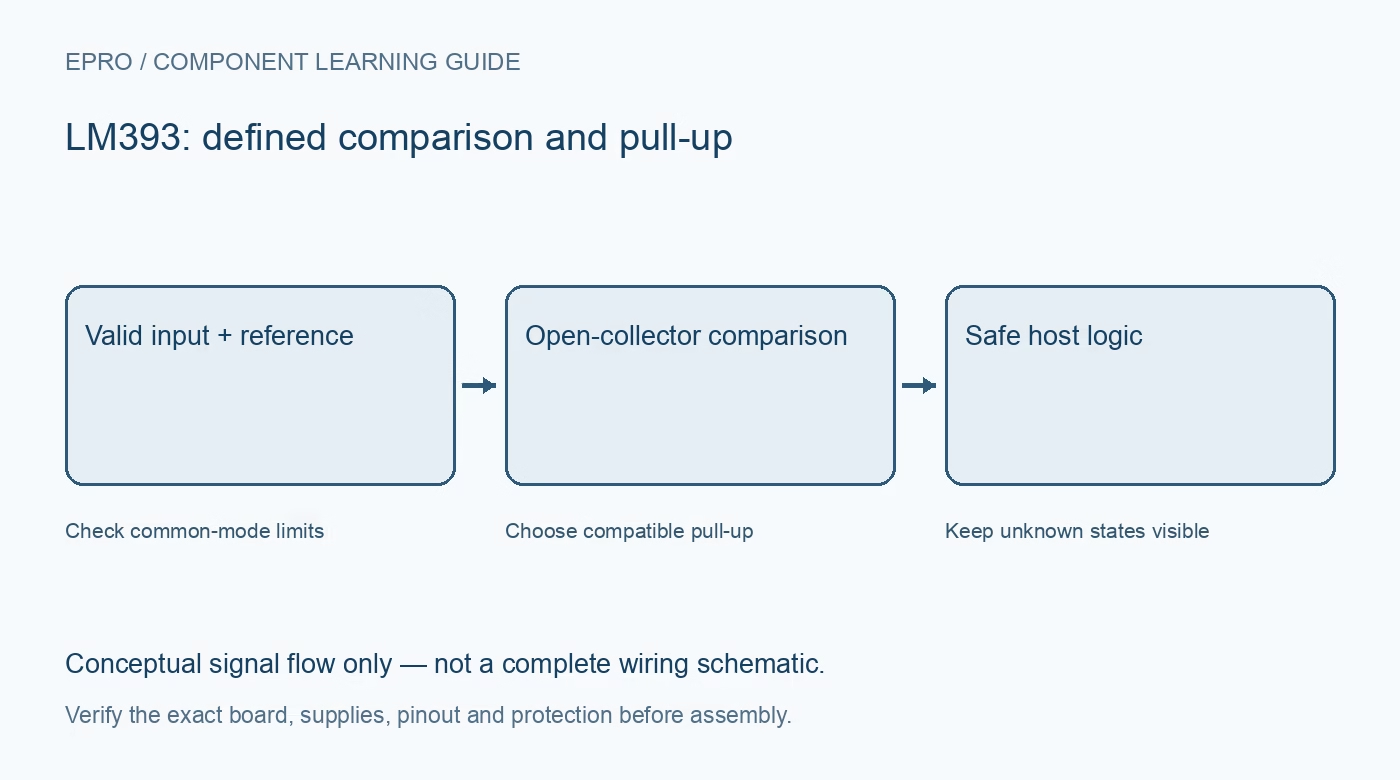
An LM393 compares two voltages and provides an open-collector output. It is not a rail-to-rail operational amplifier or a complete sensor by itself. Identify the exact variant and surrounding circuit before choosing a threshold detector for a low-voltage learning project.
Identify the fitted variant and board
The TI family document covers classic and newer B-version comparators with different specifications. An LM393-labelled module can also include an LED, potentiometer and a sensor circuit. Read the marking and schematic instead of applying one bare-chip limit or a generic module wiring diagram to every product.
Check common-mode headroom
The input range includes ground but does not extend to the positive supply rail as an unrestricted rail-to-rail comparator would. Use the table for the exact variant and temperature interval. A signal safely below the absolute maximum can still be outside the range for a valid comparison.
Provide the correct output pull-up
The output transistor can pull low but does not actively drive high. Choose a pull-up rail compatible with the receiving input and a resistance that meets low-level current and rise-time needs. Inspect existing module pull-ups before adding another path to a different supply.
Define comparison polarity
Within valid input conditions, an inverting input above the non-inverting input drives the output low; the opposite differential releases it toward the pull-up level. Near equality, input offset and noise matter. A threshold circuit should not assume an exact mathematical switching voltage without an error budget.
Choose hysteresis for a noisy boundary
Slow or noisy signals can cause repeated transitions around one reference. A documented positive-feedback network can create separate switching thresholds, but source impedance and output levels affect the calculation. Do not add a random resistor and call the result a calibrated or guaranteed debounce circuit.
Consider reference and layout quality
Supply noise, a poorly bypassed device or a high-impedance reference can disturb the apparent threshold. Keep the analog reference and sensor return path intentional. The potentiometer position on a module is not a traceable indication of the input voltage that will trip it.
Newest in the store


Keep output loads within their role
An open-collector output is a limited signal sink, not a general relay or motor driver. Begin with a compatible logic input and conservative current. A learning threshold detector does not establish electrical isolation, calibrated accuracy or independent safety protection for a battery, heater or other hazardous load.
Frequently asked questions
Can the output generate a high level without a pull-up?
Not as a normal open-collector logic output; the external circuit must establish the high state.
Does a voltage below the absolute maximum guarantee a valid comparison?
No. Check the recommended common-mode and other operating limits separately.
Availability and illustration note
The catalog search on 21 October 2026 UTC returned LM393 Low Offset Voltage Dual Comparator IC in Pakistan. Verify the exact fitted part, carrier schematic, included accessories, current price and availability before ordering; this guide does not establish compatibility from a product title alone. The illustration is an original conceptual signal-flow diagram, not a product photograph or complete wiring schematic.
Related Epro reading
For a first bench setup, review breadboard connections and continuity checks and I2C voltage-level translation. These guides do not replace the exact module schematic.
Technical references and limitations
Source: Texas Instruments LM393-family dual comparator datasheet. Electrical limits apply to the named part, not automatically to every carrier board. This is a documentation-based learning workflow, not a claim of independent hardware testing, traceable calibration or safety certification.