


AT24C32 EEPROM: 7 Capacity and Page-Write Checks

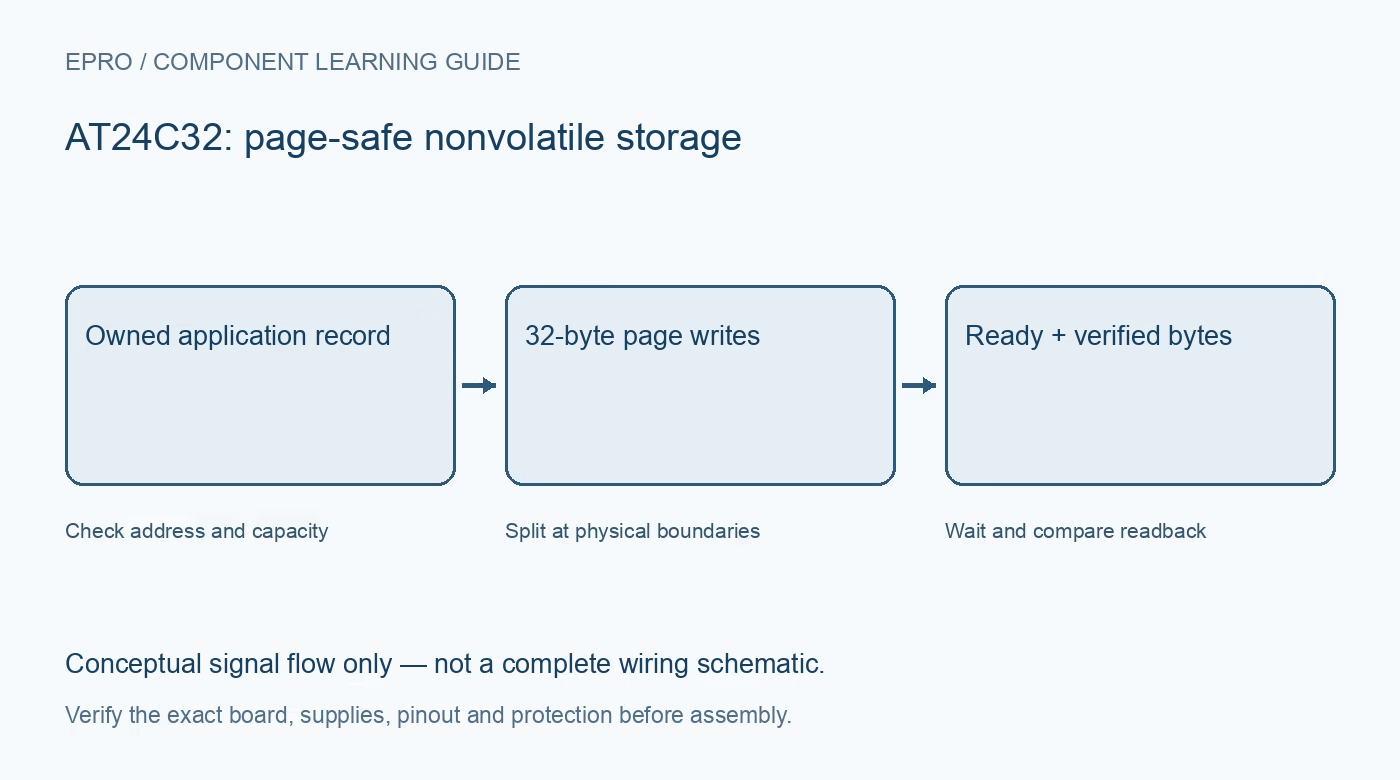
An AT24C32 stores thirty-two kilobits, which is 4096 bytes rather than thirty-two kilobytes. It may share a carrier with an RTC, but it is a separate device with its own address and protocol. This guide uses the cited AT24C32D documentation; verify other suffixes independently before applying its limits.
Identify the memory separately from the RTC
A combined clock module can include both a DS1307 and an AT24C32. Accessing the clock address does not read the EEPROM, and a clock backup cell does not redefine the memory protocol. Read the markings and schematic, including address straps and pull-ups, before selecting the board for storage.
Check suffix and operating grade
Supply and timing specifications depend on the exact device and grade. The cited automotive D-family document lists different minimum supplies for its grades. Do not apply those limits to every older AT24C32-labelled part or assume a qualified IC makes an assembled hobby board automotive-qualified.
Use byte capacity and word addressing correctly
The memory contains 4096 byte locations. Its device address selects the chip, while the word-address bytes select a location inside that chip. Do not confuse the two or use the one-byte internal addressing of a smaller EEPROM. Validate the intended buffer length against the actual capacity before transferring data.
Respect the thirty-two-byte page boundary
The cited D version supports page writes of up to thirty-two bytes within one physical page. A write starting near a page end cannot simply send thirty-two arbitrary following bytes. Crossing the boundary wraps within the same page and can alter previously loaded data rather than continuing to the next page.
Allow the self-timed write to finish
A stop condition initiates the internal programming interval. During that interval the device does not respond normally to new accesses. Use bounded acknowledge polling or the specified worst-case timing for the exact part, rather than assuming the final data acknowledgement means nonvolatile programming has already completed.
Control write protection deliberately
The WP pin protects the array when driven to its documented high state. Keep it at a defined level. In the cited device, a protected write can still acknowledge the bus sequence without changing memory, so a successful transfer return code alone is not proof that data was programmed.
Newest in the store


Plan endurance and power-loss behavior
Avoid continuously rewriting an unchanged setting and consider rotating records when application endurance requires it. Multi-byte records are not automatically atomic across a loss of power. Use validated record formats, checksums and an appropriate recovery scheme, and test only reserved disposable data rather than overwriting an existing device’s contents.
Frequently asked questions
Is AT24C32 a thirty-two-kilobyte EEPROM?
No. Thirty-two kilobits equals 4096 bytes.
Does a write acknowledgement prove saved data?
No. Internal programming, write protection and later readback must be considered.
Availability and illustration note
The catalog search on 21 October 2026 UTC returned RTC I2C Module DS1307 AT24C32 Real Time Clock Module in Pakistan. Verify the exact fitted part, carrier schematic, included accessories, current price and availability before ordering; this guide does not establish compatibility from a product title alone. The illustration is an original conceptual signal-flow diagram, not a product photograph or complete wiring schematic.
Related Epro reading
For a first bench setup, review breadboard connections and continuity checks and I2C voltage-level translation. These guides do not replace the exact module schematic.
Technical references and limitations
Source: Microchip AT24C32D/AT24C64D automotive EEPROM datasheet. Electrical limits apply to the named part, not automatically to every carrier board. This is a documentation-based learning workflow, not a claim of independent hardware testing, traceable calibration or safety certification.