


LM339 Quad Comparator: 7 Channel and Pull-Up Checks

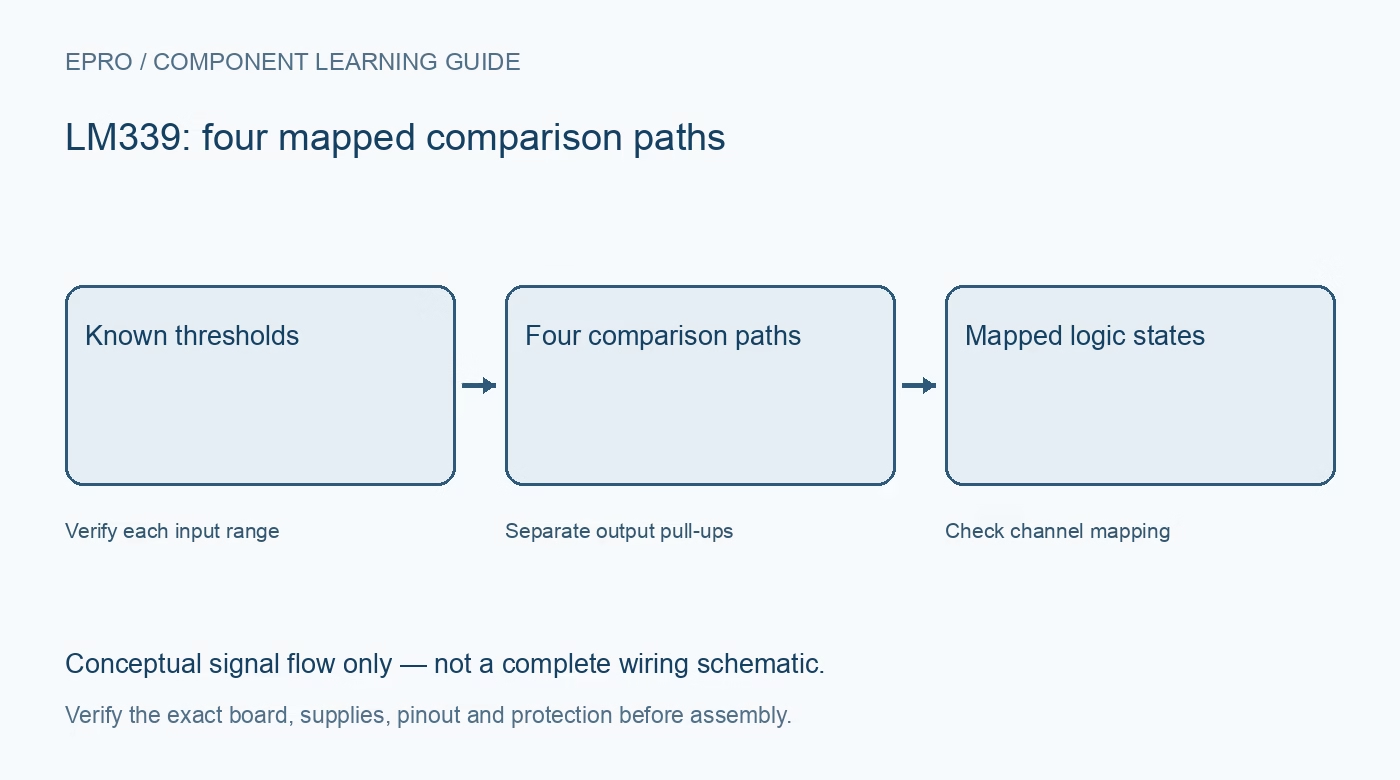
An LM339 places four voltage comparators in one package. That makes multi-threshold logic possible, but it does not supply four ADC channels or four power outputs. Plan the references, output rails and unused channels with the exact manufacturer datasheet before selecting a board.
Match the exact variant and package
Classic LM339 and newer B-version specifications must not be mixed casually. Packages and channel naming conventions also need attention: the TI document notes that manufacturers can transpose names for the first two channels while retaining the same electrical pin functions. Verify by pin number and polarity.
Keep analog inputs in valid operating range
The common-mode range includes the negative rail or ground but requires headroom below the positive rail. Absolute input tolerance is not the same as guaranteed comparison behaviour. Use the operating table for the actual variant and intended temperature range instead of assuming rail-to-rail sensing.
Provide pull-ups for the outputs
Each open-collector output needs a defined external high-state path when used as logic. Choose the pull-up rail and resistance against the receiver limits, output sink capability and required rise time. A comparator’s wider supply capability does not permit a high output voltage at an unprotected host input.
Design reference thresholds explicitly
Four comparators can share a reference network, but loading, source impedance and input bias affect the result. Independent thresholds can also interact through a poorly designed supply or ground path. Define the expected rising and falling decision points instead of treating trimmer positions as measured voltage settings.
Account for hysteresis and noise
A slowly changing sensor voltage can create repeated output transitions near a threshold. Add a documented hysteresis scheme where required and calculate its effect on both boundaries. Hysteresis is a circuit property, not an automatic consequence of having several comparators in one package.
Handle unused channels deliberately
Floating unused inputs can cause unnecessary switching and noise coupling. Use a stable documented input arrangement within valid common-mode limits and leave unused outputs unconnected. Do not tie active outputs together unless the open-collector logic function and pull-up conditions have been intentionally designed.
Newest in the store


Limit the first application to logic signals
Begin with one known input and one receiver, then verify channels separately. Check total loading and output voltage drop before adding indicators. A bare comparator or hobby module is not an independent certified overtemperature, battery or mains-safety controller, regardless of the number of available outputs.
Frequently asked questions
Does the LM339 produce numeric analog measurements?
No. It produces comparison states, not ADC codes.
Can the package pin order be inferred from channel names alone?
No. Verify the exact package drawing, pin numbers and input polarity.
Availability and illustration note
The catalog search on 21 October 2026 UTC returned LM339 Quad Comparator in Pakistan. Verify the exact fitted part, carrier schematic, included accessories, current price and availability before ordering; this guide does not establish compatibility from a product title alone. The illustration is an original conceptual signal-flow diagram, not a product photograph or complete wiring schematic.
Related Epro reading
For a first bench setup, review breadboard connections and continuity checks and I2C voltage-level translation. These guides do not replace the exact module schematic.
Technical references and limitations
Source: Texas Instruments LM339-family quad comparator datasheet. Electrical limits apply to the named part, not automatically to every carrier board. This is a documentation-based learning workflow, not a claim of independent hardware testing, traceable calibration or safety certification.