


RV3028 Arduino: 7 Reset-Flag and EEPROM Checks

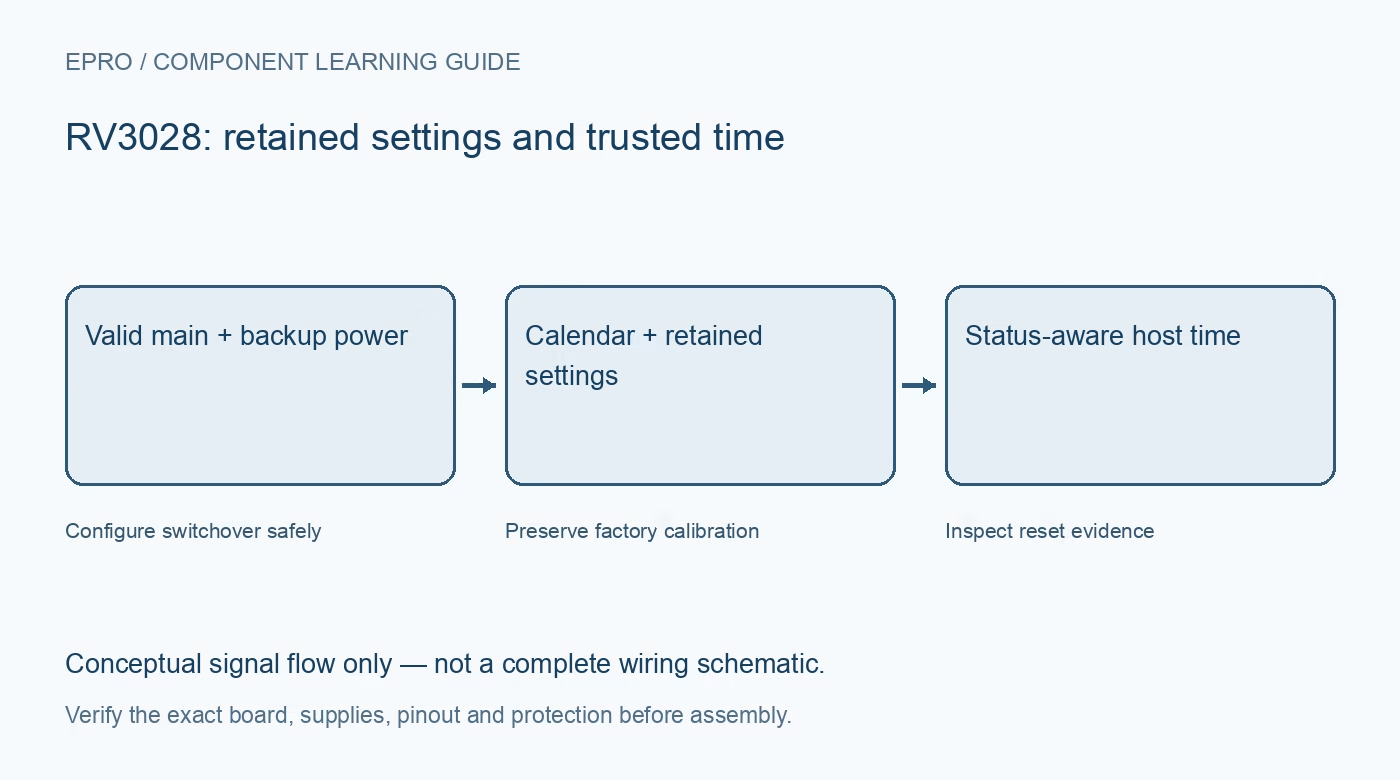
An RV3028 Arduino integration using the RV-3028-C7 module should establish both valid time and valid retained configuration. A responding I2C address is only the beginning. Use a driver matched to the module and inspect its initialization behavior before attaching a backup source or trusting a low-power operating mode.
Verify electrical and backup connections
Check the exact carrier supply, pull-ups, backup pin and any charging circuit. Confirm the host’s logic voltage and powered-off behavior. Keep the trickle charger disabled for a primary cell and do not assume a library’s default backup configuration matches the physical source attached to the board.
Allow documented startup and inspect flags
The module performs an initial EEPROM refresh at startup. Follow the manual and driver timing instead of writing immediately into an unfinished refresh operation. Read the power-on-reset and relevant status flags before clearing them, and mark time as untrusted if the evidence indicates interrupted retention.
Initialize time only with a trusted reference
Choose a known valid calendar or timestamp source and document whether application time is UTC or another convention. Do not rewrite sketch build time on every boot. A normal controller reset should usually read a healthy RTC, not silently overwrite an independently maintained timebase.
Keep calendar and UNIX representations consistent
Use the documented register formats and a device-specific library for calendar and UNIX-time functions. Do not assume that changing one representation through an arbitrary register write establishes every other representation correctly. Check driver behavior and compare interpreted values against a known reference, including a rollover boundary.
Use the EEPROM access procedure
When retained configuration needs changing, follow the required automatic-refresh control, EEbusy checks and command timing. Preserve factory and reserved values and restore the appropriate refresh behavior afterward. A single live-register write is not proof that the same backup mode will be recalled after complete power loss.
Test backup and full-power restart separately
First verify the intended main-to-backup transition and advancing time. Then, where safe and appropriate, distinguish that from a complete loss of all supplies, which exercises different retention and startup behavior. Read status before any adjustment routine so the test does not erase the evidence it is intended to inspect.
Newest in the store


Report stale or unavailable time clearly
Use bounded transfer and busy timeouts. After an intentional software-address mismatch, restore the correct configuration and verify fresh communication. Keep last-known time separate from current trusted time and record the source and age. These checks do not establish calibrated drift or complete-system battery life.
Frequently asked questions
Why does a backup setting disappear after a power cycle?
Check whether only a live mirror was changed instead of following the documented EEPROM update procedure.
Should every read update configuration EEPROM?
No. Read time without unnecessary nonvolatile writes; save configuration only when it deliberately changes.
Availability and illustration note
No matching Epro product was returned by the catalog search on 21 October 2026 UTC. This learning guide does not assert stock, a selling price or compatibility of an unidentified substitute. The illustration is an original conceptual signal-flow diagram, not a product photograph or complete wiring schematic.
Related Epro reading
For a first bench setup, review breadboard connections and continuity checks and I2C voltage-level translation. These guides do not replace the exact module schematic.
Technical references and limitations
Source: Micro Crystal RV-3028-C7 application manual. Electrical limits apply to the named part, not automatically to every carrier board. This is a documentation-based learning workflow, not a claim of independent hardware testing, traceable calibration or safety certification.