


SCD40 CO2 Sensor: 7 Range and Calibration Checks

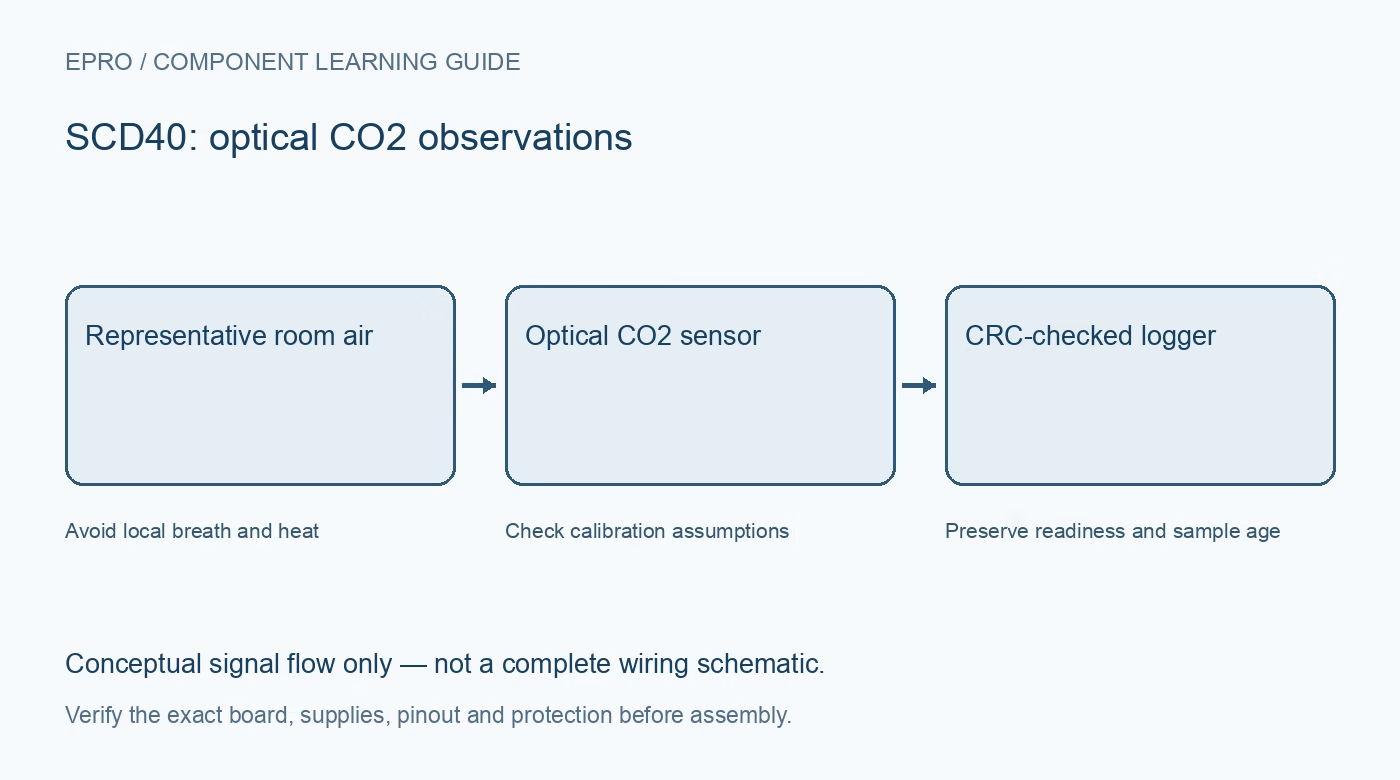
An SCD40 measures carbon dioxide using an optical photoacoustic sensing principle. It is different from a VOC sensor that calculates equivalent CO2. Select it for a documented indoor monitoring requirement, while keeping measurement uncertainty and installation conditions visible.
Distinguish the output span from specified accuracy
The SCD40 can report a wider numeric output range than its specified accuracy interval. The referenced datasheet specifies accuracy from 400 to 2,000 ppm under defined conditions. Do not advertise the full output span as an equally accurate measurement range or borrow SCD41 specifications for an SCD40.
Budget for the complete module supply
Check the sensor and carrier supply requirements, peak-current demands, decoupling and host bus levels. A regulator-fed breakout is not identical to a bare component. Avoid assuming an average current figure is enough to size the supply, especially when the host radio or display shares that rail.
Provide representative air and thermal conditions
Place the sensor where air can exchange normally, away from direct breath, local heat and obstructed openings. The RH and temperature outputs depend on integration and self-heating. A reading taken beside a warm processor may describe the enclosure rather than the occupied room.
Understand automatic calibration assumptions
Default automatic self-calibration expects periodic exposure to an appropriate known minimum background concentration. A continuously occupied room or controlled enclosure may not meet that assumption. Review the actual application history and manufacturer guidance before relying on the default, rather than assuming calibration works in every installation.
Use pressure compensation deliberately
The device can compensate CO2 output using externally supplied pressure or an altitude setting. Confirm the command’s units for the installed datasheet and driver version. Do not substitute sea-level weather-report pressure when the application expects ambient pressure at the sensor location.
Do not invent a calibration reference
Forced recalibration needs a known stable reference environment and the documented procedure. Labeling ordinary outdoor air as exactly 400 ppm without a valid reference can introduce an offset. A temperature-offset adjustment affects RH and temperature interpretation; it is not a universal correction for CO2 error.
Newest in the store


Keep safety claims separate from learning use
This guide concerns environmental logging, not a certified life-safety alarm. CO2 is not carbon monoxide, and an SCD40 is not a substitute for a certified CO, smoke or combustible-gas alarm. Do not generate gas, restrict ventilation or enter confined spaces to test a hobby sensor.
Frequently asked questions
Does equivalent CO2 from a VOC sensor mean the same thing?
No. SCD40 measures CO2 using its optical sensing principle; eCO2 is a model-derived signal with different limitations.
Should I force recalibration until readings look familiar?
No. Use a valid reference and the documented procedure; arbitrary adjustment can make a functioning sensor less accurate.
Availability and illustration note
No matching Epro product was returned by the catalog search on 21 October 2026 UTC. This learning guide does not assert stock, a selling price or compatibility of an unidentified substitute. The illustration is an original conceptual signal-flow diagram, not a product photograph or complete wiring schematic.
Related Epro reading
For a first bench setup, review breadboard connections and continuity checks and I2C voltage-level translation. These guides do not replace the exact module schematic.
Technical references and limitations
Source: Sensirion SCD4x datasheet, SCD40 variant. Electrical limits apply to the named part, not automatically to every carrier board. This is a documentation-based learning workflow, not a claim of independent hardware testing, traceable calibration or safety certification.