


SHT31 Arduino: 7 CRC, Timing and Heater-State Checks

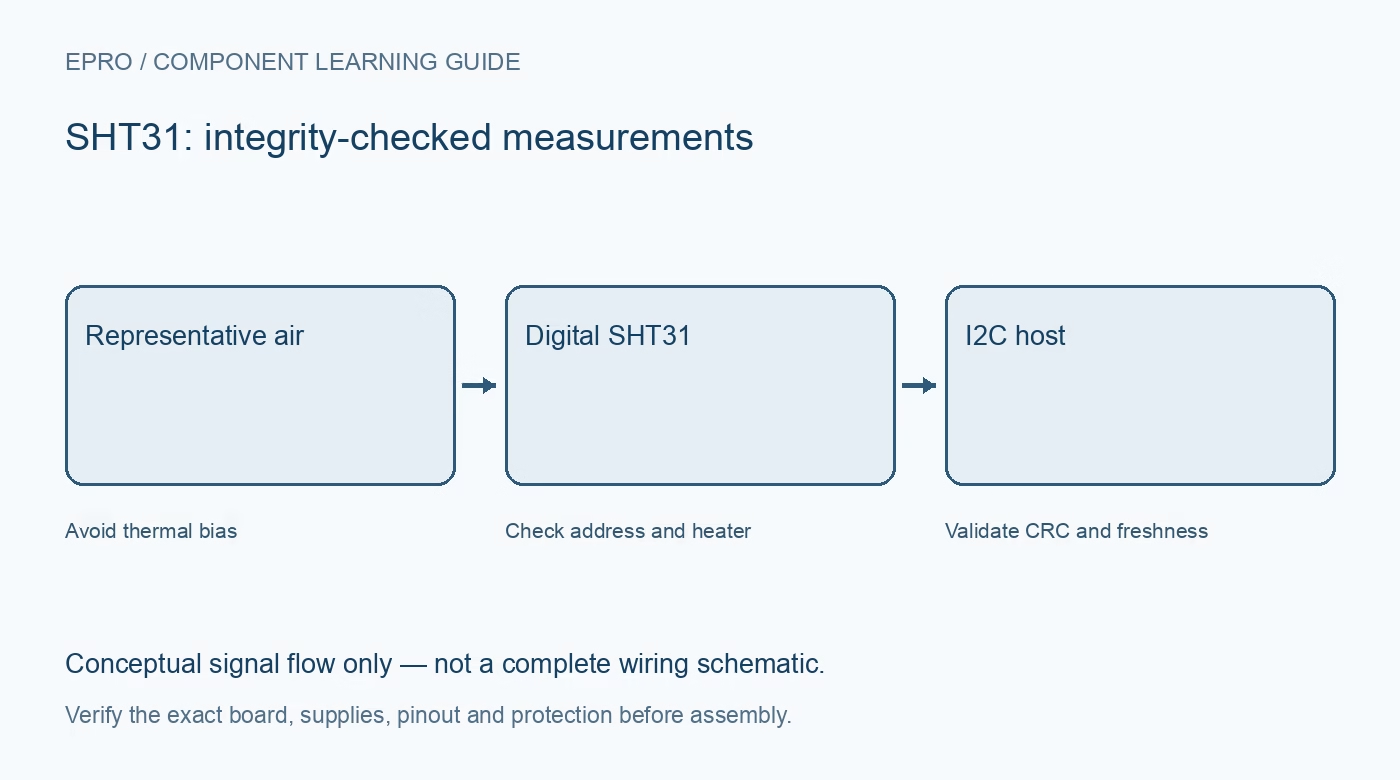
A good SHT31 Arduino integration validates the transfer before displaying the result. Use a known digital SHT31 module, a compatible bus and a driver that documents its error behaviour. Start with single-shot operation before adding periodic scheduling or alerts.
Verify the exact module and host connections
Identify SDA, SCL, supply and ground from the module schematic. Check the host board’s actual I2C pins and acceptable input voltage. If the sensor board pulls the bus to a different rail, resolve that mismatch before applying power. Short leads and one peripheral make the first test easier to interpret.
Confirm the selected address
Expect 0x44 with ADDR low or 0x45 with ADDR high. A scanner is a communication aid, not a complete functional test. Pass the selected address explicitly to the library. Do not reconnect address jumpers with the board energized, and do not leave the selection floating.
Choose one documented measurement command
Single-shot commands encode repeatability and whether clock stretching is enabled. Pick a command supported by the host driver and respect its maximum conversion time. A no-clock-stretching command still requires waiting for the conversion; it does not make results available instantly.
Read and validate the whole result
A complete paired response contains two temperature bytes, a CRC byte, two humidity bytes and another CRC byte. Reject short reads. For this family the CRC-8 uses polynomial 0x31, initialization 0xFF and no final XOR. Do not reuse a different humidity sensor’s initialization merely because its polynomial looks similar.
Convert only accepted measurement words
After integrity checks, combine bytes as unsigned 16-bit values. The documented scaling is temperature = -45 + 175 × raw/65535 and relative humidity = 100 × raw/65535. Keep raw words in a diagnostic log so byte-order or scaling mistakes can be investigated without guessing from formatted decimals.
Check heater status and freshness
Read status through the supported driver and keep the heater disabled for ordinary ambient logging. Attach a successful-sample timestamp. If CRC validation, initialization or communication fails, increment an error counter and show unavailable or stale data. Do not silently replace a failed sample with zero humidity.
Newest in the store


Run a controlled recovery check
Try an incorrect address in software and verify a clear failure message. Restore the working address, power cycle normally and confirm initialization succeeds again. If periodic mode is added later, follow the documented break-command sequence before incompatible commands rather than mixing transaction modes opportunistically.
Frequently asked questions
Can I ignore the CRC because readings look reasonable?
A reasonable-looking number can still come from a damaged transfer. Check both CRC bytes when reliable logging matters.
Why does temperature increase after a diagnostic test?
The internal heater may have been enabled. Check status and let the assembly settle before treating values as ambient.
Availability and illustration note
No matching Epro product was returned by the catalog search on 19 October 2026. This learning guide does not assert stock, a selling price or compatibility of an unidentified substitute. The illustration is an original conceptual signal-flow diagram, not a product photograph or complete wiring schematic.
Related Epro reading
For a first bench setup, review breadboard connections and continuity checks and I2C voltage-level translation. These guides do not replace the exact module schematic.
Technical references and limitations
Source: Sensirion SHT3x-DIS datasheet. Electrical limits apply to the named part, not automatically to every carrier board. This is a documentation-based learning workflow, not a claim of independent hardware testing, traceable calibration or safety certification.