


TSL2561 Arduino: 7 Raw-Channel and Saturation Checks

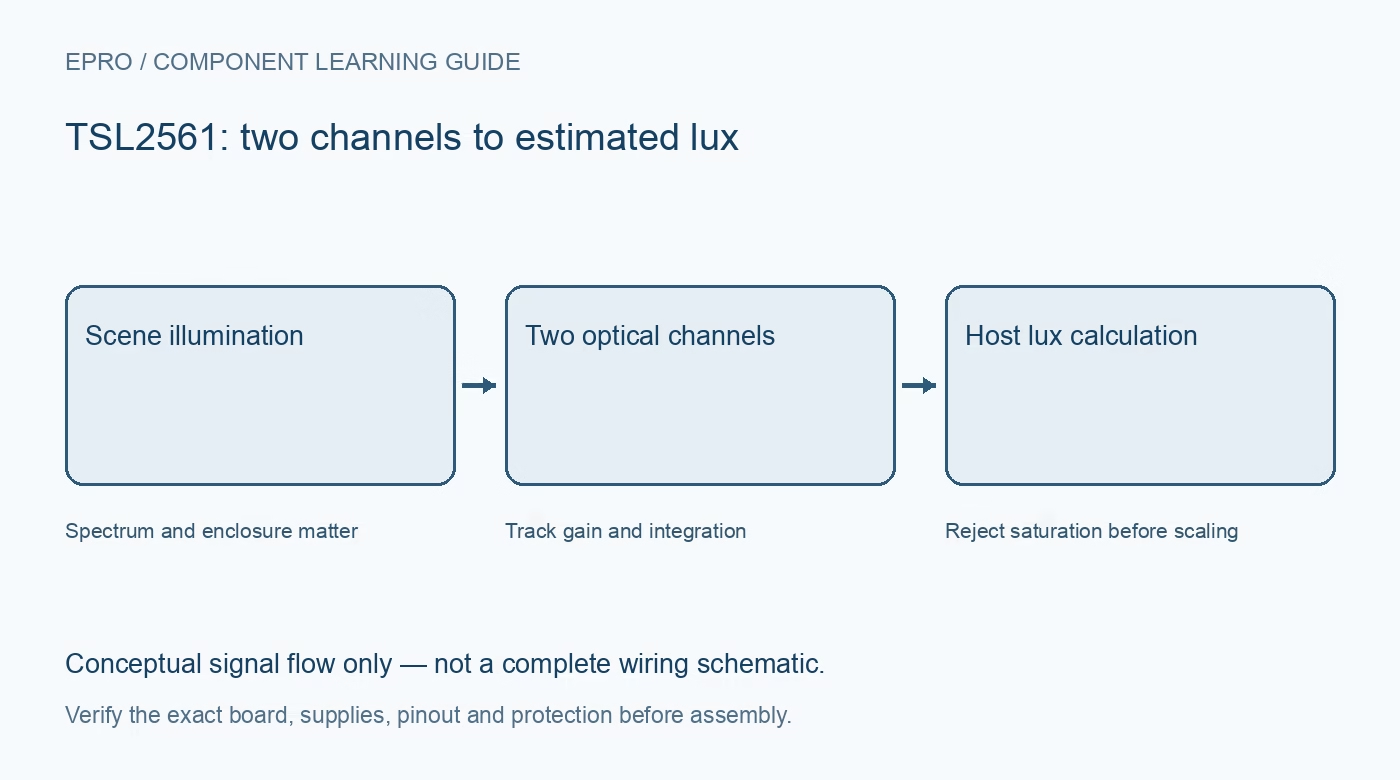
A TSL2561 Arduino workflow should expose raw channels and settings alongside the lux estimate. That small diagnostic record makes it easier to distinguish darkness, a communication failure, saturation and an incorrect scaling assumption.
Check the exact board and address connection
Map supply, ground, SDA and SCL with power disconnected. Verify the carrier’s regulator and pull-ups rather than assuming every board accepts the same voltage. The sensor’s normal address options include 0x29, 0x39 and 0x49; match the driver to the hardware selection.
Verify identification and power-up state
Use a maintained TSL2561 driver and check its initialization result. Ensure the sensor is enabled for measurement rather than leaving it powered down. A responding address with unchanged data can reflect a configuration problem, not necessarily a failed optical element.
Choose an explicit baseline configuration
Begin with a known gain and integration time in moderate room light. Record the setting in each diagnostic line. The nominal integrations are 13.7, 101 and 402 ms, with 1× or 16× gain. Do not change settings invisibly while comparing raw counts from separate runs.
Read both channels using the documented transaction
The datasheet recommends word reads for the two-byte channel registers. Respect byte ordering and the command/register addressing convention used by the driver. Reject incomplete transactions rather than combining a new low byte with an old high byte left in a buffer.
Check saturation before calculating lux
Use the threshold appropriate to the active integration setting. If sensitivity is changed, wait for a complete fresh integration before accepting the next sample. Do not interpret a driver’s overflow sentinel, zero or error return as a valid lighting condition without reading the API contract.
Keep scaling consistent with the active configuration
The documented lux calculation accounts for channel ratio, gain, integration and package-related coefficients. Use a compatible implementation and pass the actual settings. Applying a fixed counts-to-lux multiplier to every configuration can make a gain change appear to be a real lighting change.
Newest in the store


Test dimming and brightening without claiming calibration
Shade the sensor with a noncontact cover and then expose it to normal room illumination. Log raw channels, lux, active settings, status and sample time. Avoid staring into intense sources or using a laser as a test lamp. A sensible trend is a functional check, not proof of traceable illuminance accuracy.
Frequently asked questions
Why did lux change after I enabled automatic gain?
Check whether the new settings were included in conversion and whether a full new integration completed before readout.
Can a zero result mean communication failure?
Depending on the driver, yes. Keep status separate from the physical value and inspect the documented error convention.
Availability and illustration note
No matching Epro product was returned by the catalog search on 19 October 2026. This learning guide does not assert stock, a selling price or compatibility of an unidentified substitute. The illustration is an original conceptual signal-flow diagram, not a product photograph or complete wiring schematic.
Related Epro reading
For a first bench setup, review breadboard connections and continuity checks and I2C voltage-level translation. These guides do not replace the exact module schematic.
Technical references and limitations
Source: TAOS TSL2560/TSL2561 datasheet. Electrical limits apply to the named part, not automatically to every carrier board. This is a documentation-based learning workflow, not a claim of independent hardware testing, traceable calibration or safety certification.