


74HC4050 Level Shifter: 7 Direction and Threshold Checks

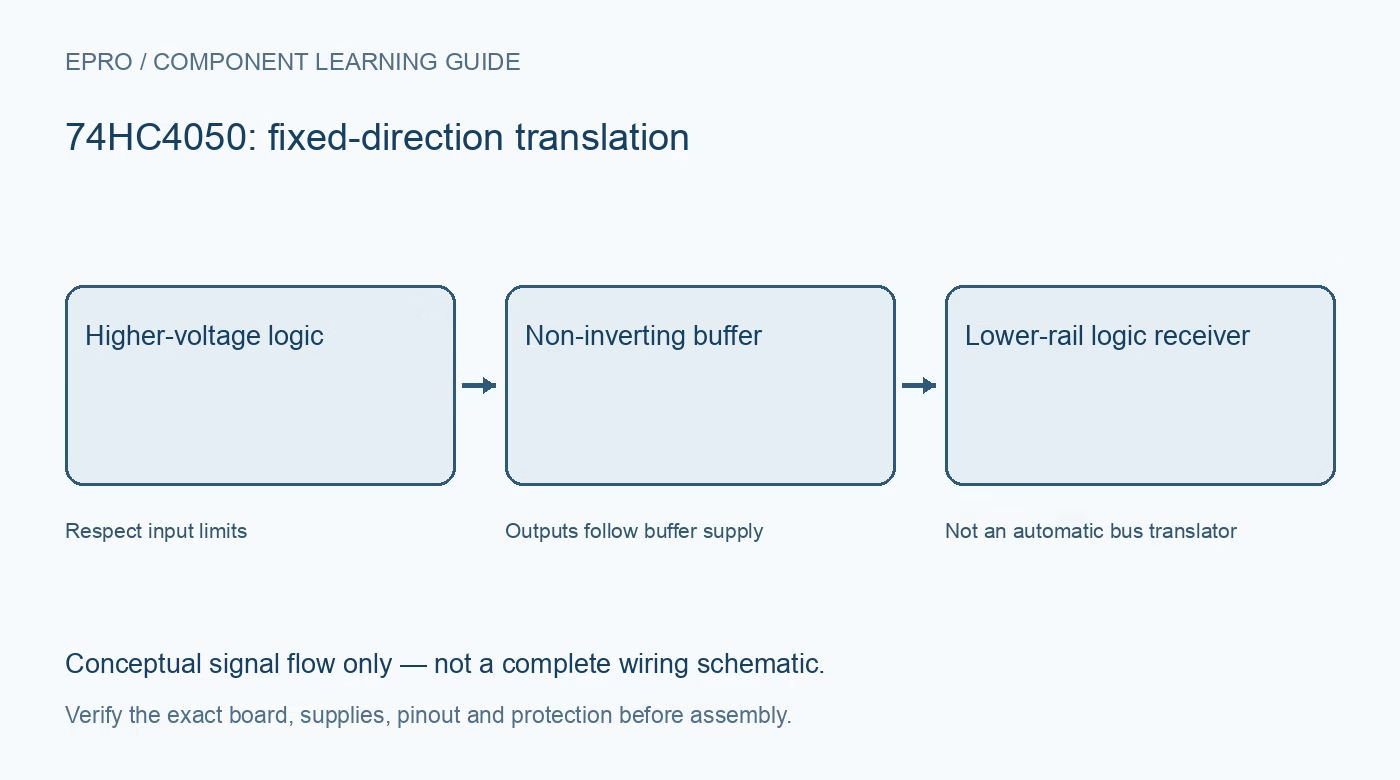
A 74HC4050 is a six-channel non-inverting buffer with overvoltage-tolerant inputs. It can support defined high-to-low logic translation, but it is not an automatic bidirectional bus translator or an analog signal converter. Match the exact part and signal direction to the interface.
Confirm the named device and manufacturer
The cited Nexperia 74HC4050 specifies its own supply and input conditions. Do not transfer those limits to any ordinary HC buffer or to an unidentified 4050 variant. Read the package marking and current manufacturer datasheet before relying on overvoltage tolerance.
Choose the output logic supply
The Nexperia part supports a recommended supply from 2 to 6 V, with output levels referenced to that supply. Supplying the buffer from a suitable lower rail can provide lower-voltage logic outputs. This does not create a regulated power supply for another board.
Respect input limits and thresholds separately
The documented input range extends above the supply, but the signal must still meet valid high and low thresholds and transition requirements. Overvoltage tolerance is not the same as recognizing every lower-voltage source. Verify the source output guarantees against the receiver thresholds at the actual rail.
Keep the direction explicit
Each channel runs from its input to its output and preserves logic polarity. It cannot detect a bus turnaround automatically. Select another interface approach for shared bidirectional lines when required; do not connect both ends of an I2C data line through a push-pull buffer without a valid bus design.
Include timing and load in the budget
Propagation delay, rise and fall times and output voltage depend on supply and load. A low-frequency static test cannot prove reliable operation at a fast serial clock rate or over a long cable. Review the receiving device’s setup and hold requirements with realistic wiring capacitance.
Give unused inputs defined levels
Unconnected CMOS inputs can assume indeterminate states and increase susceptibility to noise or unnecessary switching. Tie unused inputs to appropriate valid levels as documented, while leaving their unused outputs free. Add local supply decoupling and keep the reference ground connection sound.
Newest in the store


Check startup and power-off assumptions
Do not infer power-off isolation or harmless unpowered operation from powered input tolerance alone. Examine the complete power sequence and exact device conditions. Start with a low-risk logic input load, not a motor or other power load, and validate the interface before depending on it in equipment.
Frequently asked questions
Is this a bidirectional level converter?
No. It has fixed input-to-output channels and is intended here for defined high-to-low logic translation.
Does a 3.3 V output guarantee a 5 V receiver accepts it?
Not by itself. Compare the output guarantee with the receiver’s required input threshold.
Availability and illustration note
No matching Epro product was returned by the catalog search on 21 October 2026 UTC. This learning guide does not assert stock, a selling price or compatibility of an unidentified substitute. The illustration is an original conceptual signal-flow diagram, not a product photograph or complete wiring schematic.
Related Epro reading
For a first bench setup, review breadboard connections and continuity checks and I2C voltage-level translation. These guides do not replace the exact module schematic.
Technical references and limitations
Source: Nexperia 74HC4050 datasheet. Electrical limits apply to the named part, not automatically to every carrier board. This is a documentation-based learning workflow, not a claim of independent hardware testing, traceable calibration or safety certification.