


BC547 Transistor: Gain Grades, Pinout and Buying Checks

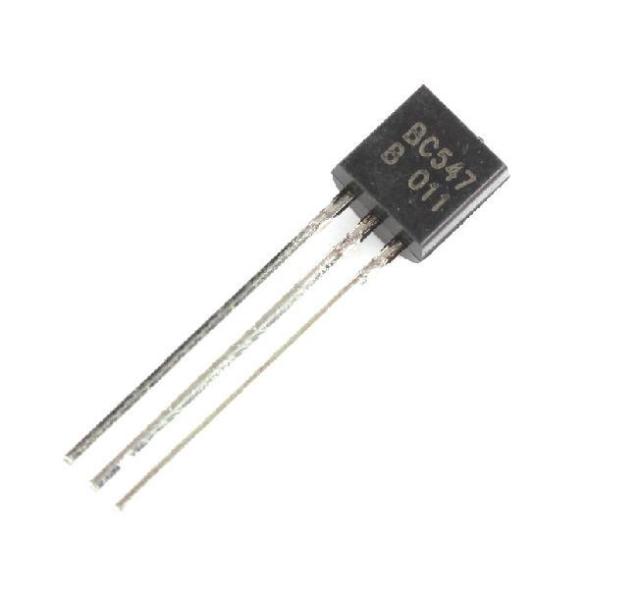
A BC547 transistor is a small-signal NPN device used in low-current switching and amplifier circuits. Choosing one means checking the full suffix, package pinout, operating point and thermal limits. It is not a general motor driver simply because it has three leads and a familiar low price.
Identify the complete device and package

Read the supplied manufacturer marking and any A, B or C gain-grade suffix. Confirm the package drawing and its viewing direction before mapping collector, base and emitter. A similar flat-faced transistor can use a different arrangement. The catalog name is a selection starting point, not a complete part-identification record.
Understand the gain-grade specification
BC547 gain grades describe ranges under stated test conditions. Gain also changes with current, temperature and operating region. Do not design a switch by dividing the intended load current by a convenient typical hFE copied from another grade. Saturation specifications use particular base and collector currents and must be interpreted accordingly.
Respect small-signal current and heat limits
Read the exact device’s collector-current, voltage and package-dissipation ratings together. The product is not intended to replace a power transistor or motor-driver module indiscriminately. Even a load below an absolute-maximum current can cause excessive dissipation if collector voltage remains high. Leave appropriate design margin rather than targeting every maximum simultaneously.
Choose a base resistor for the actual drive
A GPIO or switchable supply should not connect directly to the base without current limiting. Select base current using the load, saturation requirements and source capability, with resistor tolerance and base-emitter voltage considered. Add a defined inactive state where startup or disconnected wiring could otherwise leave the transistor unintentionally on.
Use amplifier advice only for an amplifier operating point
A linear amplifier needs suitable biasing and signal headroom, while a saturated switch is intentionally driven into a different region. Those are not interchangeable uses of one resistor formula. Check input and output signal ranges and avoid assuming that a circuit drawn for another supply or transistor grade has the same bias point.
Choose a first test that is easy to diagnose
A resistor-limited indicator LED makes a better initial experiment than an inductive or high-current load. Measure actual current and voltages and compare with the intended operating region. A successful small test is not a reliability qualification or evidence that the seller part meets every datasheet parameter.Newest in the store


Relevant Epro listing
Product information and prices were checked on 19 October 2026. This is a current snapshot, not a historical price associated with the publication timestamp. Stock, accessories and checkout prices can change. Listing claims are not independent performance or authenticity certifications.
| Product | Checked price | Stock |
|---|---|---|
| BC547 NPN Bi-polar Junction Transistor in Pakistan | PKR 8 | In stock |
Frequently asked questions
Do A, B and C suffixes always mean identical gain?
No. They identify gain groupings under the manufacturer’s stated conditions.
Can BC547 replace any power transistor?
No. Compare voltage, current, dissipation, drive and package requirements for the actual circuit.
Related Epro reading
Review breadboard connections before assembling a prototype. For controller expansion, the Mega 2560 pin guide explains why pin names and electrical limits must be checked together.
Technical references and test limitations
This guide uses the documentation linked below. The procedures are for a controlled, low-voltage learning setup; no independent hands-on test of the particular seller board is claimed. Record the actual part markings, wiring and firmware version before drawing conclusions from a test.