


SEN55 Air Quality Module: 7 Index and Airflow Checks

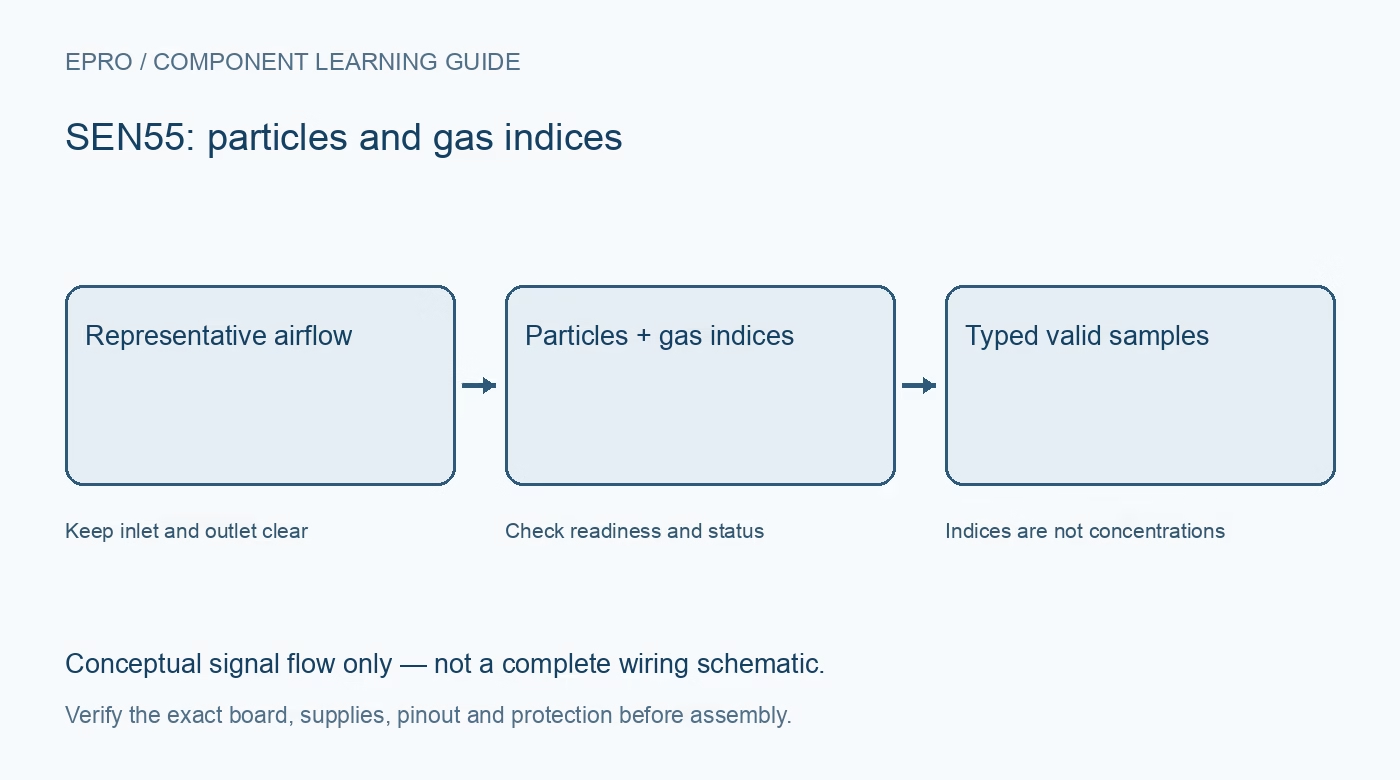
The SEN55 combines particulate, humidity, temperature and gas-index measurements in a fan-assisted module. Its outputs represent different physical and algorithmic quantities, so an effective design begins by deciding which signals the application can interpret responsibly.
Confirm the SEN5x variant
The family members do not all expose the same measurement set. The SEN55 includes VOC and NOx indices alongside particulate matter, humidity and temperature. Check the exact module designation and driver support before treating a missing field on another SEN5x variant as a defective sensor.
Keep indices separate from concentrations
VOC Index and NOx Index are not direct ppm or ppb concentrations of a specific gas. The particulate mass outputs use their own units and particle-size definitions. Do not combine all fields into an unexplained universal safe-air score or rename an index as a gas concentration.
Provide a suitable power supply
The referenced module supply is 4.5 to 5.5 V. Verify current capacity, connector pinout, decoupling and logic-level compatibility separately. A 5 V power input is not blanket permission to pull a microcontroller’s I2C pins to 5 V or power the fan from a small GPIO.
Design for the intended airflow path
Keep inlet and outlet openings unobstructed and follow the integration guidance for enclosure placement. Recirculating the module’s outlet directly to its inlet can make a neatly packaged assembly measure an unrepresentative sample. Avoid forcing unsuitable external airflow through a module designed around its own fan.
Allow startup and algorithm stabilization
The different signals have different switch-on and stabilization behaviour. A numerically present gas index immediately after startup should not be treated as equivalent to conditioned operation. Inspect the driver’s invalid-value and warm-up conventions before designing a dashboard or logging schema.
Plan cleaning and status monitoring
The module includes fan-cleaning behaviour and diagnostic status. Keep those conditions visible in the application and follow the manufacturer’s maintenance guidance. Do not spray cleaners, introduce dust deliberately or disassemble the optical path to perform an improvised calibration test.
Newest in the store


Define a limited environmental-monitoring role
A documented sensor module can support useful indoor trends, but a hobby assembly is not automatically a regulatory air-quality instrument or certified gas alarm. It does not replace CO, smoke or combustible-gas safety devices, and it should not be used to declare a potentially hazardous space safe to enter.
Frequently asked questions
Does NOx Index give a direct nitrogen-dioxide concentration?
No. It is an index signal, not a gas-specific concentration in ppb.
Can the module work inside a sealed box?
A sealed box prevents representative air exchange. Follow the manufacturer’s inlet, outlet and enclosure integration requirements.
Availability and illustration note
No matching Epro product was returned by the catalog search on 21 October 2026 UTC. This learning guide does not assert stock, a selling price or compatibility of an unidentified substitute. The illustration is an original conceptual signal-flow diagram, not a product photograph or complete wiring schematic.
Related Epro reading
For a first bench setup, review breadboard connections and continuity checks and I2C voltage-level translation. These guides do not replace the exact module schematic.
Technical references and limitations
Source: Sensirion SEN5x datasheet, SEN55 variant. Electrical limits apply to the named part, not automatically to every carrier board. This is a documentation-based learning workflow, not a claim of independent hardware testing, traceable calibration or safety certification.