


BH1750 Light Intensity Sensor: Choosing a Lux Module

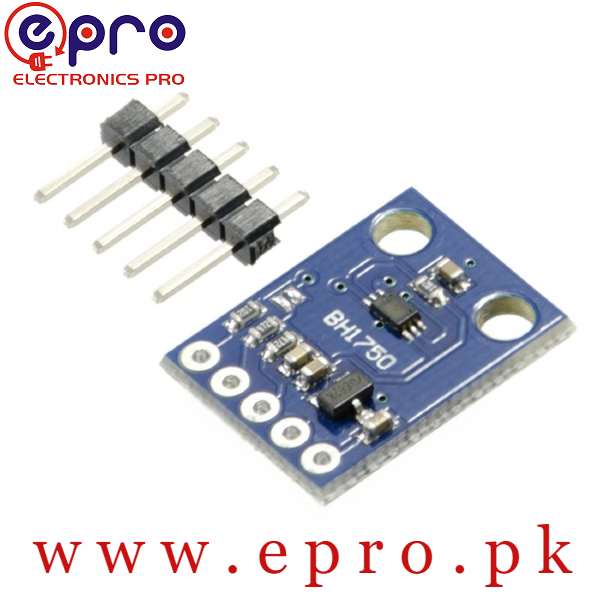
A BH1750 light intensity sensor reports a digital estimate of illuminance rather than a raw resistance. It is useful for comparing room lighting or experimenting with automatic display brightness. Choose the complete module by its supply, bus wiring, optical placement and measurement behavior, not by the presence of an I2C connector alone.
Understand what lux measures

Lux describes illuminance at the sensor surface. It is not the same as a lamp’s total luminous output, and it is not a direct measure of plant photosynthetic photon flux. Sensor angle, distance, shadows and the spectrum of the source affect results. A reading from an uncalibrated module should not be presented as a certified workplace-lighting measurement.
Separate the IC supply from the breakout input
The ROHM BH1750FVI datasheet specifies a 2.4–3.6 V IC supply. A breakout may add a regulator, but its VIN label does not prove that SDA and SCL are level shifted. Inspect the board schematic or documented circuit. Confirm the voltage to which bus pull-ups connect before linking the module to a controller.
Choose a mode with enough settling time
High-resolution mode has a typical measurement time of 120 ms and a stated maximum of 180 ms at the default setting. Its nominal resolution is 1 lx; high-resolution mode 2 uses 0.5 lx. These increments are not accuracy guarantees. The faster low-resolution mode trades resolution for shorter integration. Readings requested too soon may be stale or invalid.
Plan the I2C address
The address selection input permits two addresses, commonly written as 7-bit 0x23 and 0x5C. Check the ADDR connection for the actual board. Two modules on the same address cannot be independently selected on one ordinary bus. Choose different supported addresses or use a suitable multiplexer rather than changing only a software variable.
Consider the optical installation
Keep the light-sensitive area unobstructed and avoid placing a bright indicator LED beside it. A protective window changes the light reaching the sensor; tint, dirt and angle can matter. Maintain a repeatable mounting direction when comparing readings. A phone application and a loose module may disagree because they observe different positions and use different calibration.
Define a useful acceptance check
Start with short wires, a documented supply and a single sensor on the bus. Check that the address responds, then compare a fixed location under a steady lamp, a gently shaded sensor and a brighter position. Values should change plausibly, but this is a functional check rather than calibration. Record mode, integration settings and mounting before collecting a time series.Newest in the store


Relevant Epro listing
Product information and prices were checked on 19 October 2026. This is a current snapshot, not a historical price associated with the publication timestamp. Stock, accessories and checkout prices can change. Listing claims are not independent performance or authenticity certifications.
| Product | Checked price | Stock |
|---|---|---|
| Light Intensity Sensor BH1750 in Pakistan | PKR 460 | In stock |
Frequently asked questions
Does 1 lx resolution mean 1 lx accuracy?
No. Resolution is the size of the reported increment; accuracy depends on the device specification and measurement conditions.
Can it directly measure plant PPFD?
No. Lux and photosynthetic photon flux are different measurements. Do not assume a universal conversion for all light spectra.
Related Epro reading
Review breadboard connections before assembling a prototype. For controller expansion, the Mega 2560 pin guide explains why pin names and electrical limits must be checked together.
Technical references and test limitations
This guide uses the documentation linked below. The procedures are for a controlled, low-voltage learning setup; no independent hands-on test of the particular seller board is claimed. Record the actual part markings, wiring and firmware version before drawing conclusions from a test.