


FM24CL64B F-RAM: 7 Voltage and Record-Integrity Checks

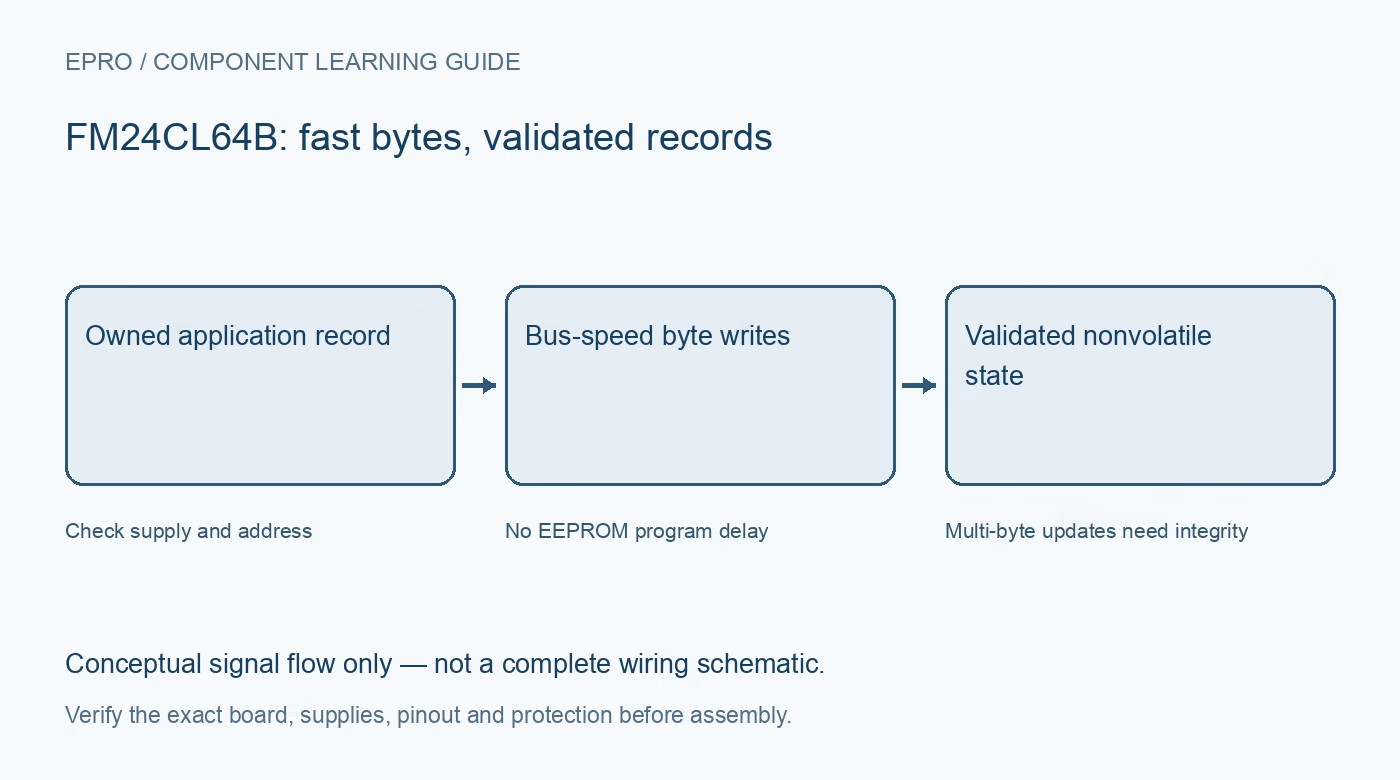
The FM24CL64B is a sixty-four-kilobit I2C ferroelectric memory, providing 8192 bytes of nonvolatile storage. Its bus-speed writes differ from EEPROM programming cycles. Verify the B-suffix device and carrier before selecting it for frequently updated low-voltage records; speed does not remove the need for data-integrity design.
Verify the full part and supply range
The cited device operates from 2.7 V to 3.65 V. Do not assume a similarly packaged EEPROM supply limit applies to it. Inspect the carrier for pull-up rails, address straps and regulator behavior, and confirm all host signals remain compatible during normal operation and powered-off conditions.
Use capacity and internal addresses correctly
Sixty-four kilobits means eight kilobytes, not sixty-four kilobytes. The host must send the documented internal address bytes and remain inside the 8192-byte array. Address pins select which device responds on the bus; they are not substitutes for the byte-location address inside the memory.
Distinguish immediate writes from EEPROM
Each transferred data byte is committed through the documented bus-speed mechanism, without a separate EEPROM-style programming delay. There is no page buffer requiring the same thirty-two-byte rollover handling as the cited EEPROM. Nevertheless, host buffer limits, array bounds and transaction errors still constrain a safe transfer.
Understand when data changes
In the documented protocol a byte write completes before its acknowledgement. Stopping a transaction after complete data bytes does not roll those bytes back. A partially sent record can therefore contain a mixture of old and new fields even though no long programming interval remains after the transfer.
Define the write-protect state
The WP pin can protect the entire memory array when asserted as documented. Verify whether a carrier straps it or exposes it to the host. Do not depend on an assumed floating state for important protection, and distinguish a rejected protected write from a valid stored byte value.
Read endurance and retention with conditions
The specified endurance is very high but not literally infinite, and read accesses also participate in the device’s endurance mechanism. Data retention depends on temperature. Avoid turning a headline retention figure into an unconditional lifetime promise for every environment, board or application access pattern.
Newest in the store


Design validated records and recovery
Use record length, version, checksum and a commit or redundant-copy strategy for important multi-byte state. Test only reserved disposable addresses and verify content after completed operations. Fast nonvolatile writes reduce one storage burden, but they do not automatically make a complete application update atomic, authenticated or immune to loss of power.
Frequently asked questions
Does F-RAM require EEPROM-style write-completion polling?
The cited device writes at bus speed without that separate programming delay; follow its own protocol.
Can a complete record be partially updated despite fast writes?
Yes. Individual bytes can commit before a multi-byte record finishes, so application-level integrity is still needed.
Availability and illustration note
No matching Epro product was returned by the catalog search on 21 October 2026 UTC. This learning guide does not assert stock, a selling price or compatibility of an unidentified substitute. The illustration is an original conceptual signal-flow diagram, not a product photograph or complete wiring schematic.
Related Epro reading
For a first bench setup, review breadboard connections and continuity checks and I2C voltage-level translation. These guides do not replace the exact module schematic.
Technical references and limitations
Source: Infineon FM24CL64B serial F-RAM datasheet. Electrical limits apply to the named part, not automatically to every carrier board. This is a documentation-based learning workflow, not a claim of independent hardware testing, traceable calibration or safety certification.