


MCP23008 Arduino: 7 Safe-Startup and Event Checks

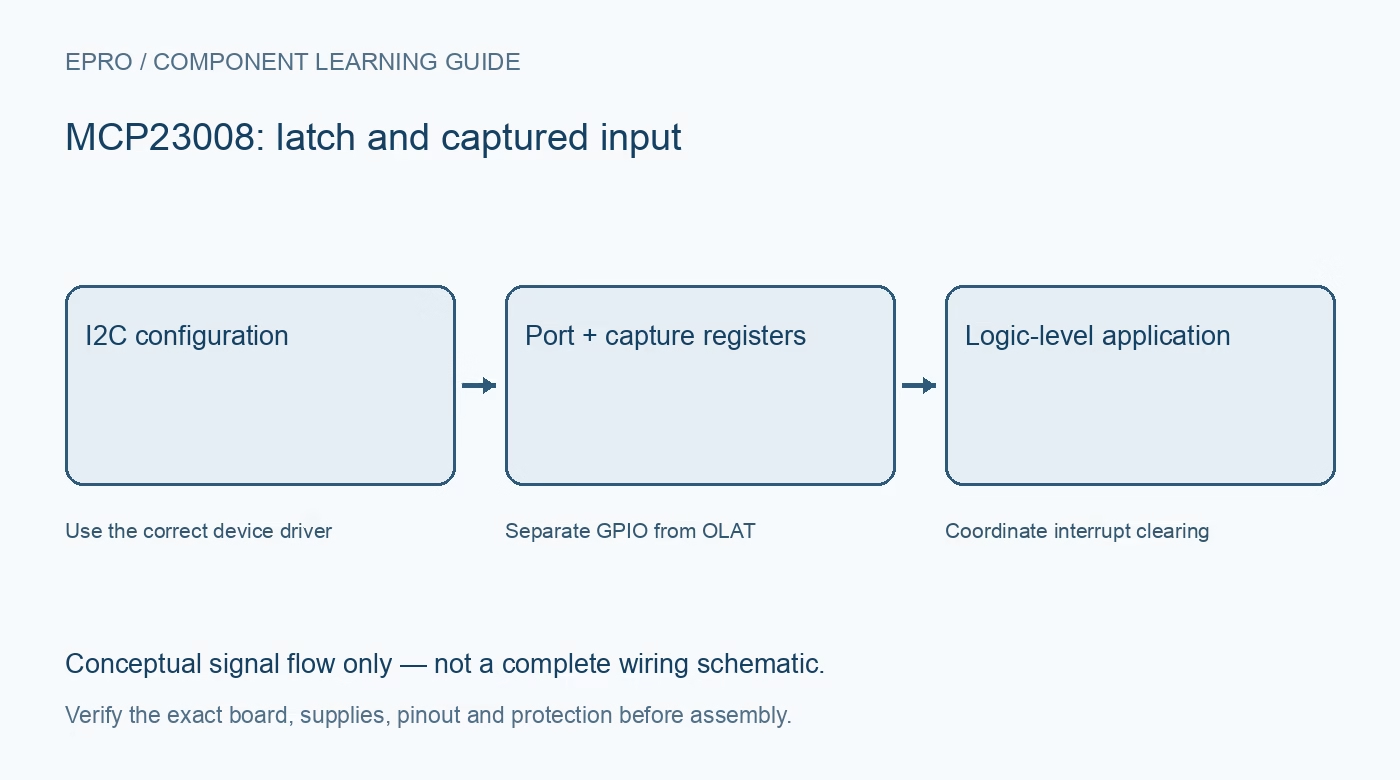
A small MCP23008 Arduino demonstration should prove input, output and error handling separately. Begin with a supported input and one conservative indication load, keeping the current GP7 restriction and interrupt-clearing behaviour visible in the initialization plan.
Verify the carrier before applying power
Identify supply, ground, reset, address and I2C connections from the exact schematic. Check every pull-up rail against the host and expander limits. Use short wires and disconnect power before changing straps; a generic I2C connector label is not a guarantee of identical board wiring.
Initialize the exact device and address
Select an MCP23008 driver rather than a similarly named SPI or quasi-bidirectional expander library. Require successful communication at the physically selected address. A scan is only an acknowledgment check, so continue by verifying the configuration that the application expects.
Assign a permitted input and GP7 output
Choose a supported button input such as GP0, with the documented pull-up configuration. Configure GP7 as output as required by the cited current datasheet, giving it a harmless defined value even if unused. Keep switch debounce separate from the electrical direction setting.
Set safe latch values before direction changes
Preload intended output values before enabling the relevant drivers where the API permits. Preserve unrelated bits with a synchronized latch shadow or OLAT access. Reading loaded GPIO levels and writing them back can unintentionally turn a physical voltage error into a new commanded output state.
Test polling before adding interrupts
Print the button’s raw and debounced states at a modest rate and verify a low-current output independently. Do not use a rapid read loop as evidence of high-speed event capture. Establish correct wiring and direction first so interrupt debugging does not hide a basic pin-allocation mistake.
Coordinate interrupt capture and acknowledgment
Select change-versus-default comparison intentionally, then service the captured value using the documented registers. GPIO or INTCAP reads can clear the interrupt; default-comparison conditions can remain active while the input still differs. Avoid competing polling and event routines that clear or consume each other’s observations.
Newest in the store


Check recovery without energizing a load
Use an incorrect software address to verify the error path, then restore it and read back direction and latch state. Report unavailable input data and failed output commands explicitly. A hobby bus transaction is not an independent safety confirmation that a downstream actuator reached a safe physical state.
Frequently asked questions
Why might INT stay active after a read?
A default-comparison input may still meet the interrupt condition; inspect the comparison mode and actual pin state.
Can software debounce replace a defined input level?
No. Correct pull-ups and wiring are needed before debounce can interpret meaningful transitions.
Availability and illustration note
No matching Epro product was returned by the catalog search on 21 October 2026 UTC. This learning guide does not assert stock, a selling price or compatibility of an unidentified substitute. The illustration is an original conceptual signal-flow diagram, not a product photograph or complete wiring schematic.
Related Epro reading
For a first bench setup, review breadboard connections and continuity checks and I2C voltage-level translation. These guides do not replace the exact module schematic.
Technical references and limitations
Source: Microchip MCP23008/MCP23S08 datasheet, revision I. Electrical limits apply to the named part, not automatically to every carrier board. This is a documentation-based learning workflow, not a claim of independent hardware testing, traceable calibration or safety certification.